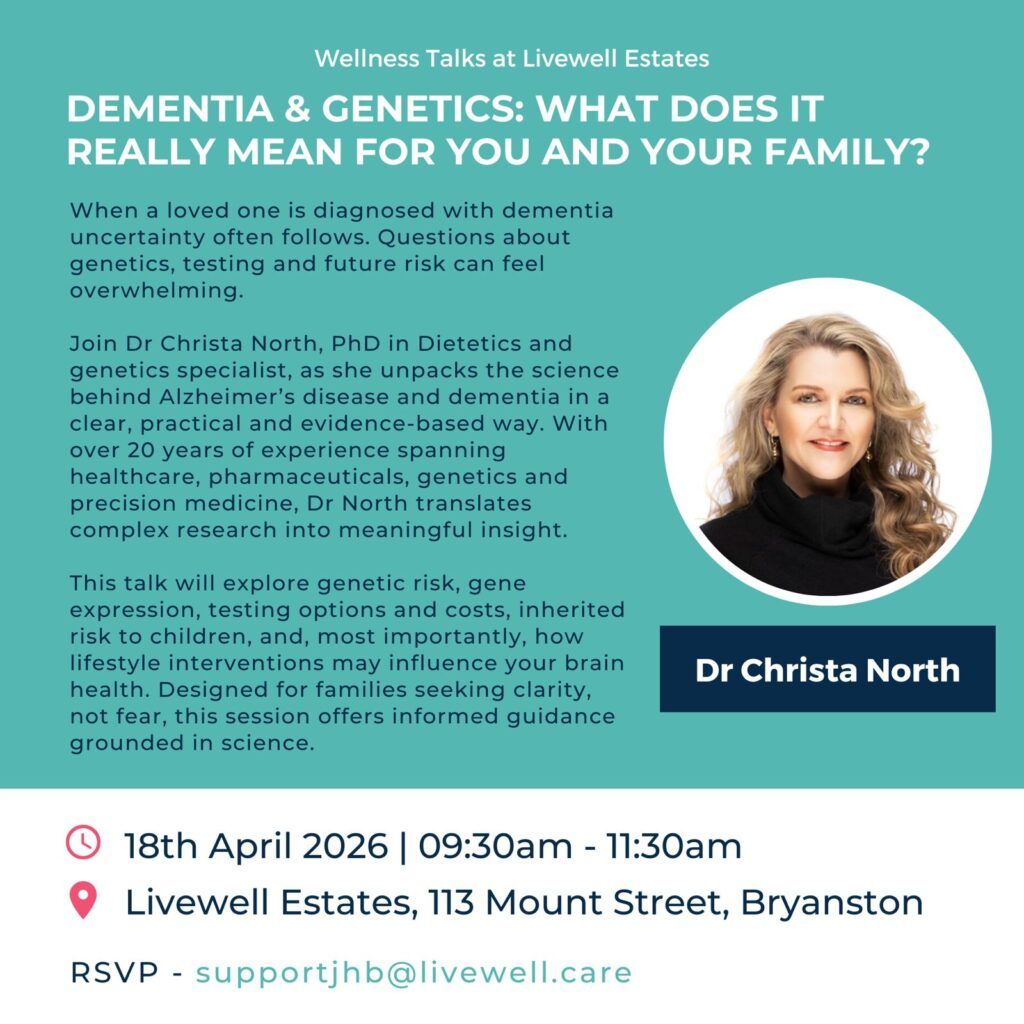

When dementia affects a family, one of the most difficult questions often lingers beneath the surface: Will this happen to me too? Advances in genetics have made it possible to better understand risk, but they have also introduced new uncertainty. If a parent has dementia, does that mean it is inevitable for their children? Or is there meaningful room to intervene?
According to Dr Christa North, genetics specialist and PhD in Dietetics, both genetics and lifestyle matter but for most people, genetics is not destiny.
Genetics is not the whole story
The majority of dementia cases, including late-onset Alzheimer’s disease, are considered complex. They are influenced by multiple genes interacting with vascular health, metabolic factors, environmental exposures, and lifelong habits. A major Lancet Commission report estimates that around 45% of dementia cases could theoretically be prevented or delayed by addressing modifiable risk factors across the lifespan. This reframes dementia from something purely inherited to something, in part, influenced.
There are rare exceptions. A very small subset of families carry single-gene (autosomal dominant) mutations, classically in the APP, PSEN1, or PSEN2 genes, that can cause early-onset Alzheimer’s disease, sometimes from as early as the 30s. In these families, the mutation can be close to deterministic. However, these cases account for less than 1% of all Alzheimer’s diagnoses.
For most people, genes raise or lower baseline risk, but they do not operate alone. Long-term brain health is strongly shaped by vascular health, insulin sensitivity, inflammation, sleep quality, hearing, vision, and daily behavioural patterns.
Understanding gene expression
One of the most misunderstood concepts in dementia risk is gene expression. Every cell in the body contains the same DNA — the full genetic instruction manual. However, not every instruction is active at the same time. Gene expression refers to which genes are “switched on” and how active they are.
Dr North explains it simply: your DNA is the recipe book; gene expression is which recipes are being cooked today. You may own hundreds of recipes, but you do not cook all of them at once. In the same way, genes are turned up, turned down, or temporarily activated depending on what the body needs and the environment it is exposed to.
Common risk genes, such as APOE ε4, influence how the brain handles cholesterol transport and amyloid. They increase risk, but they do not guarantee dementia. Many APOE ε4 carriers never develop Alzheimer’s disease, and many individuals without the variant still do.
Lifestyle does not change the genetic code itself, but it does influence the conditions in which those genes operate — blood flow, blood pressure, metabolic health, inflammation, toxin exposure, sleep, and cognitive stimulation. Over decades, these factors meaningfully shape how risk unfolds.
The most evidence-based lifestyle interventions
The strongest scientific evidence supports a multidomain, whole-system approach. Dementia develops through the accumulation of multiple small contributors, which means prevention efforts must address several areas simultaneously.
The major pillars supported by international guidelines and clinical trials include:
- Control vascular and metabolic risks: Maintain healthy blood pressure, cholesterol, blood sugar, and weight.
- Engage in regular physical activity: Include both aerobic movement and strength training.
- Avoid smoking and limit harmful alcohol use.
- Follow a Mediterranean-style eating pattern: Emphasise plants, legumes, whole grains, fish, healthy fats, and minimise ultra-processed foods.
- Address hearing and vision loss promptly.
- Treat depression and support mental health.
- Stay socially and cognitively engaged through structured learning, hobbies, and meaningful connection.
Large multidomain trials, such as the FINGER study, demonstrate that combining diet, exercise, cognitive training, and vascular monitoring can help preserve cognitive function in at-risk older adults. Research also highlights additional modifiable contributors, including physical inactivity, obesity, hypertension, diabetes, high LDL cholesterol, social isolation, air pollution, head injury, and low education.
Should you consider genetic testing?
Genetic testing can be valuable in specific circumstances. It is particularly relevant when there is a strong family pattern of early-onset dementia involving multiple relatives in their 30s to 50s. In those cases, testing for rare deterministic mutations is typically done alongside formal genetic counselling. Testing for common risk variants, such as APOE, requires more careful consideration. These variants influence risk but are not deterministic. Without proper interpretation and counselling, results may cause unnecessary anxiety.
Before proceeding with testing, individuals should consider:
- Will this result change what I do?
- Am I emotionally prepared for the outcome?
- Do I have access to appropriate pre- and post-test counselling?
- Am I testing for a rare mutation or a common risk variant?
A practical “start now” plan for families
For individuals with a family history of dementia, proactive steps can begin immediately. Brain health is shaped over decades, and early intervention carries long-term value.
A practical starting plan includes:
- Know and manage key health markers such as blood pressure, glucose, lipids, and weight.
- Move most days and include resistance training.
- Eat for vascular and metabolic health.
- Protect sleep and treat suspected sleep apnoea.
- Assess and correct hearing and vision loss.
- Avoid smoking and keep alcohol within low-risk limits.
- Maintain strong social connections and ongoing mental stimulation.
- Consider a multidomain approach that integrates lifestyle changes with regular medical monitoring.
The emerging science offers clarity rather than certainty. For most families, dementia risk reflects a combination of inherited predisposition and decades of environmental influence. While genes may set the starting point, lifestyle helps determine the trajectory.
Livewell Wellness Talk with Dr Christa North